
London Trafalgar Square is a square in central London that commemorates the Battle of Trafalgar (1805), a British naval victory of the Napoleonic Wars. The original name was to have been “King William the Fourth’s Square”, but George Ledwell Taylor suggested the name “Trafalgar Square”.
The area had been the site of the King’s Mews since the time of Edward I. In the 1820s the Prince Regent engaged the landscape architect John Nash to redevelop the area. Nash cleared the square as part of his Charing Cross Improvement Scheme. The present architecture of the square is due to Sir Charles Barry and was completed in 1845. The square is a popular site for political demonstrations, is the site of Nelson’s Column, and related sculptures of note.
London’s main sights: Trafalgar Square Museums Palaces Kew Gardens Westminister Big Ben Lords Cricket Madam Tussauds London Eye Sherlock Homes’ home Leicester Square IMAX Theater Wimbledon St. Pauls Cathedral Outside Links: Jack the Ripper Tour Britrail England Youth Flexipass
London Trafalgar Square
The square consists of a large central area surrounded by roadways on three sides, and stairs leading to the National Gallery on the other. The roads which cross the square form part of the busy A4 road, and prior to 2003, the square was surrounded by a one-way traffic system on all sides. Underpasses attached to Charing Cross tube station still allow pedestrians to avoid traffic. Recent works have reduced the width of the roads and closed the northern side of the square to traffic.
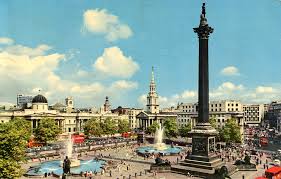
The London Trafalgar square. Its one of the most refreshing places in the world. Nelson’s Column is in the center of the square, surrounded by fountains designed by Lutyens in 1939 and four huge bronze lions sculpted by Sir Edwin Landseer; the metal used is said to have been recycled from the cannon of the French fleet. The column is topped by a statue of Lord Nelson, the admiral who commanded the British Fleet at Trafalgar.
On the north side of the square is the National Gallery and to its east the St Martin’s-in-the-Fields church. The square adjoins The Mall via Admiralty Arch to the southwest. To the south is Whitehall, to the East Strand and South Africa House, to the north Charing Cross Road and on the west side is Canada House.
Trafalgar Square Statue
At the corners of the square are four plinths; the two northern ones were intended to be used for equestrian statues, and thus are wider than the two southern. Three of them hold statues: George IV (northeast, the 1840s), Henry Havelock (southeast, 1861, by William Behnes), and Sir Charles James Napier (southwest, 1855). Mayor of London Ken Livingstone controversially expressed a desire to see the two generals replaced with statues that “ordinary Londoners would know”.
In 1888 the statue of General Charles George Gordon was erected. In 1943 the statue was removed and, in 1953, re-sited on the Victoria Embankment.
Trafalgar Square History
The Square has become an enormously important symbolic social and political location for visitors and Londoners alike, developing over its history from “an esplanade peopled with figures of national heroes, into the country’s foremost place politique,” as historian Rodney Mace has written. Its symbolic importance was demonstrated in 1940 when the Nazi SS developed secret plans to transfer Nelson’s Column to Berlin following an expected German invasion, as related by Norman Longmate in If Britain Had Fallen (1972).
The fourth plinth The fourth plinth on the northwest corner was intended to hold a statue of William IV but remained empty due to insufficient funds.
Later, the agreement could not be reached over which monarch or military hero to place there. In 1999, the Royal Society of Arts conceived the idea of the Fourth Plinth Project, which temporarily occupied the plinth with a succession of works commissioned from three contemporary artists.
These were: Ecce Homo, by Mark Wallinger (1999) Regardless of History, by Bill Woodrow (2000) Monument, by Rachel Whiteread (2001) Wallinger’s Ecce Homo – whose title, in Latin, means “behold the man”, a Biblical reference – was of a life-sized man. Atop the huge plinth, designed for larger-than-life statuary, it looked minuscule.
Some commentators said that, far from making the man look insignificant, his apparent tininess drew the eye powerfully; they interpreted it as a commentary on human delusions of grandeur. Whiteread’s Monument, by an artist already notable for her controversial Turner Prize-winning work “House” and the Judenplatz Holocaust Memorial in Vienna, was a cast of the plinth in transparent resin and placed upside-down on top of the original. Following the exhibition project, some wished to see it continue in this role.
Various companies have used the plinth (often without permission) as a platform for publicity stunts, including a model of David Beckham by Madame Tussauds. The London-based American harmonica player Larry Adler jokingly suggested erecting a statue of Moby Dick, which would then be called the “Plinth of Whales”. The best use of the fourth plinth remains the subject of debate. On March 24, 2003, an appeal was launched by Wendy Woods, the widow of the anti-apartheid journalist Donald Woods, hoping to raise £400,000 to pay for a nine-foot high statue of Nelson Mandela by Ian Walters.
Trafalgar Square Pigeons
The relevance of the location is that South Africa House, the South African high commission, scene of many anti-apartheid demonstrations, is also located on Trafalgar Square. A committee convened to consider the RSA’s late-1990s project concluded that it had been a success and “unanimously recommended that the plinth should continue to be used for an ongoing series of temporary works of art commissioned from leading national and international artists”.
After several years in which the plinth stood empty, the new Greater London Authority assumed responsibility for the fourth plinth and started its own series of temporary exhibitions: Marc Quinn: Alison Lapper Pregnant (September 15, 2005) Thomas Schutte: Hotel for the Birds (scheduled for April 2007) Quinn’s Alison Lapper Pregnant is a 3.6m marble torso-bust of Alison Lapper, an artist who was born with no arms and shortened legs due to a condition called phocomelia.
Pigeons
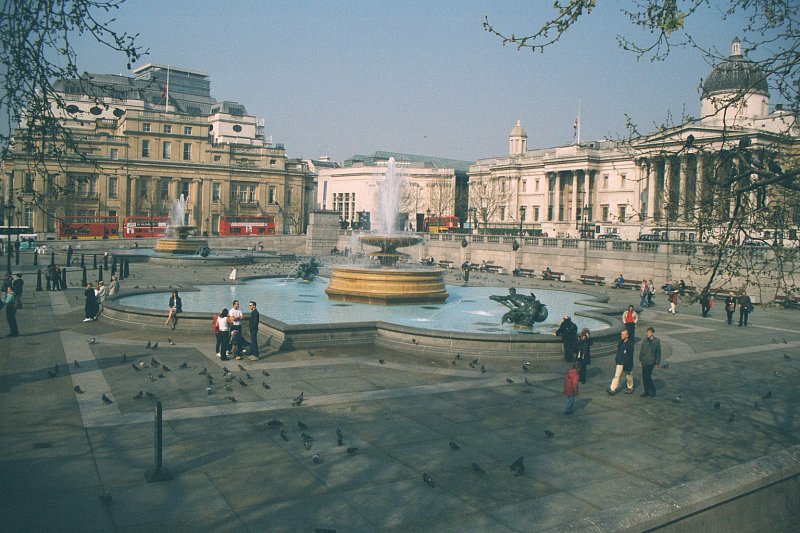
Pigeons The square is a popular tourist spot in London and used to be particularly famous for its pigeons (rock doves). Feeding the pigeons was a popular activity with Londoners and tourists.
The National Portrait Gallery displays a 1948 photograph of Elizabeth Taylor posing there with bird seed so as to be mobbed by birds. The desirability of the birds’ presence has long been contentious: their droppings look ugly on buildings and damage the stonework, and the flock, estimated at its peak to be 35,000, was considered to be a health hazard.
In 1996, police arrested one man who was estimated to have trapped 1500 birds for sale to a middleman; it is assumed that the birds ended up in the human food chain. In 2000, the sale of bird seed in the square was controversially terminated and other measures were introduced to discourage the pigeons, including the use of trained falcons. Supporters of the pigeons and some tourists continued to feed the birds, but, in 2003, Ken Livingstone enacted by-laws to ban the feeding of pigeons within the square. There are now relatively few birds in Trafalgar Square and it is used for festivals and hired out to film companies, in a way that was not feasible in the 1990s.