
York England Travel Guide: York always features in any of the ‘England top attractions lists’. Its turbulent history can be traced back nearly 2,000 years. It begins in earnest in AD71 when the Romans, at the height of their powers, conquered the Celtic tribes known as the Brigantes and founded Eboracum which, by the fourth century, was the capital of lower Britain.
Main sights: York Minster Barley Hall All Saints Church Bar Convent Holy Trinity Church Clifford’s Tower Fairfax House Guildhall National Railway Museum Outside Links:
York England Travel
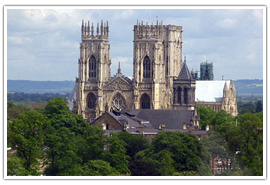
York Minster – the widest Gothic cathedral in northern Europe. York Minster was built between the 12th and the 15th Century and is the largest Gothic church in England. It is 524 feet (160m) long and 249 feet (76m) wide. The height from floor to vault is over 90 feet (27m). The twin west towers are about 184 feet (56m) high, and the lantern tower 234 feet (71m). A visit to the Central Tower offers excellent views over the city.
York Minister
The Foundations Museum under the Minster shows how the present building was constructed on the site of a Norman Cathedral, which was itself built on a Roman Fort.
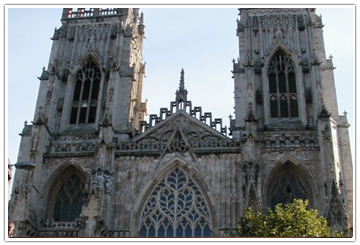
Voluntary guides are usually on duty from 09.30 (10.00 in winter) until approximately half an hour before evensong. Two million people visit York Minster every year, whether as tourists or pilgrims.
All Saints Church
All Saints North Street All Saints possesses a fine collection of original 14th century stained glass. Two windows of note depict “Corporal acts of Mercy”, and the “Price of Conscience”. Look for the stained glass figure depicted wearing eyeglasses.
The church dates back as far as the 12th century, though much of what remains was added in the 14th and 15th centuries. The West tower, 120 feet high, is the 15th century. The church was heavily restored after a 1997 fire. Admission: Free.
All Saints Pavement
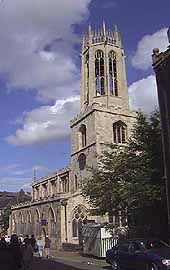
All Saints Pavement High Ousegate. The second All Saints church in York is easily noticed due to its striking octagonal 15th-century lantern tower. In the medieval period, a lantern was hung from the tower to act as a beacon for travelers in the Forest of Galtres to the north. The church, first mentioned in the Domesday Book, is the burial place of 39 Lord Mayors. Look for the 12th-century door knocker depicting the Mouth of Hell. Open: 8am-5.30pm for visitors. Admission: Free.
Bar Convent Chapel
This small convent of Catholic sisters was founded in 1686. The splendid neo-classical domed chapel was built in 1766 to designs by Thomas Atkinson.
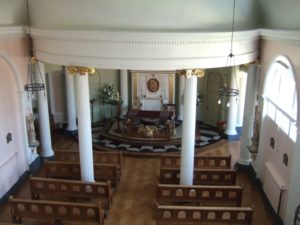
The dome is painted white, with accents in gold. Eight fluted columns support the dome. Joseph Hansom, the inventor of the hansom cab, was baptized here in 1803.
Holy Trinity Church
Holy Trinity Church Goodramgate. Tucked behind a row of houses said to be among the oldest in England is the 15th century Holy Trinity church. There was a church on this site at the time of the Domesday Book, but most of the present church exterior dates from the 17th and 18th centuries. The red brick entrance was built in 1776. The interior is notable for its irregular box pews, also 17th century, and some fine medieval stained glass. Admission: Free
Barley Hall
Barley Hall small medieval “living history” museum. Barley Hall is a rambling complex of two medieval buildings, hidden away in the heart of York and only accessible by a honeycomb of ancient alleys and snickets.
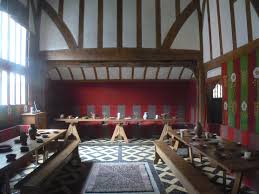
The whole complex has been taken back to precisely the way it would have been at the time of King Richard III (into the 1480’s). Everything in Barley Hall is as authentic as possible, and all items of fixtures and fittings are made using ancient materials and techniques.
Clifford’s Tower
Clifford’s Tower medieval remains of York Castle, perched on its high mound above the river. For the sheer drama of its setting, and its chequered history, there is little in York to rival Clifford’s Tower. The present stone building dates from the 13th century, when it was built by Henry III, and is believed to be named after John, Lord Clifford, a Lancastrian rebel against Edward II, whose body was hung there in chains after the Battle of Boroughbridge in 1322.
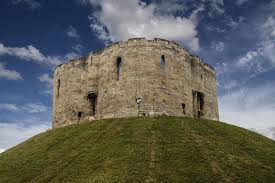
Clifford’s Tower was the scene of what was perhaps one of the most terrible events in York’s history. In 1190 the Jews of York sought refuge there after being attacked by a local mob. They were given the choice of being either baptized or killed, but they took the third option and committed mass suicide. At this time the tower was built of timber and so burned to the ground. It was rebuilt in stone.
Fairfax House
Fairfax House an elegantly restored Georgian townhouse. Fairfax House is one of the finest eighteenth-century townhouses in England and is home of the famous Noel Terry collection of furniture. Fairfax House is perhaps the finest 18th-century house in the North of England. It was designed by John Carr of York and typifies the best of mid-18th-century rococo decoration.
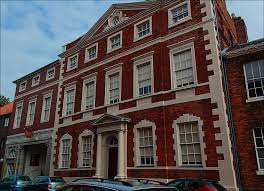
Sadly, successive owners had allowed the house to decay to a state of near collapse by the early 1980s when it was acquired by York Civic Trust with a grant from the National Heritage Memorial Fund. Further grants enabled the Trust to restore the house to its former glory, and in October 1984 it was opened by the Duchess of Kent. Follow signs for the city center, castle area, and Jorvick Centre.
Guildhall
Guildhall the medieval hall of York’s powerful trade guilds. The Guildhall is an integral part of York’s history. It is built on the site of an earlier guildhall or ‘common Hall’ which is referred to in a charter of Henry III of 1256. Building work on the present Guildhall began in 1445 and the accounts still survive. The cost of a boatload of stone from Cawood (10 shillings and 3 pence) was given to the workmen for a drink when the foundations were laid. A council meeting was recorded there in May 1459.
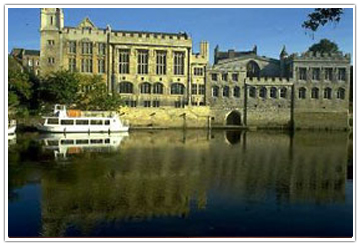
The building received a direct hit from an incendiary bomb on 29th April 1942. The stone shell of the building and the remains of the bomb remained standing as a grim reminder until 1956 when restoration work was started. The Guildhall was re-opened by Queen Elizabeth, the Queen Mother on 21st June 1960.
Other Places to Visit:
- Jorvik Viking Centre – York’s Viking past reconstructed and explained.
- York City Wall – You can still walk the wall begun by the Romans.
- National Railway Museum – The largest railway museum in the world.
- Treasurers House – the original home of the treasurer of York Minster, now a medieval museum.
- Roman Bath Museum – Roman Baths discovered beneath a modern pub
- The Shambles – a narrow, rambling medieval street.
- York Castle Museum – a superb museum with realistic historical street scenes from the past.
York is easily accessible by bus or by rail, particularly from London. The closest airports are at Leeds or Manchester. York’s major attractions are within walking distance of one another, though there is an excellent bus service for the walking enthusiasts. Road: A64 leads to York approx. 208 miles from London.
Suggested Itineraries
Exploring York’s historic city center is like taking a trip back in time. The city’s rich cultural heritage dates back to Roman times, but the flavor of Viking Jorvik is still alive at the outstanding Jorvik Viking Centre, and the medieval architecture of the city is outstanding.
York is dominated by the imposing bulk of York Minster with its superb stained glass windows, but spare some time to explore one of York’s other fine medieval churches, and wander the narrow streets of The Shambles area. Don’t leave York without taking a walk on the city walls that were first erected by the Roman legions. Along the walls, you can visit the medieval gateways to the city.
York always features in any of the ‘England top attractions lists’. Its turbulent history can be traced back nearly 2,000 years. It begins in earnest in AD71 when the Romans, at the height of their powers, conquered the Celtic tribes known as the Brigantes and founded Eboracum which, by the fourth century, was the capital of lower Britain. There are lots of accommodation options and self-catering in York and it is a great place for a short city break.
There are lots of accommodation options and self-catering in York and it is a great place for a short city break.
Traveling by Train in England and London – Information on getting and reading your train ticket, the high speed, and regional train system; a link of train schedules.
More Info On- East Riding of Yorkshire, West Yorkshire county travel guide, Best Time to Visit England