
Life in the United Kingdom, A Journey to British Citizenship, United Kingdom Society
Chapter 3 – Part IV
UK Nationality Home Chapter 2 Part I Part II Part III Chapter 3 Part I Part II Part III Part IV Chapter 4 Part I Part II Part III Part IV Part V Part VI Chapter 5 Part I Part II Part III Part IV Part V Part VI Part VII Chapter 6 Part I Part II Part III Part IV Part V
CUSTOMS AND TRADITIONS
Tourist guides commonly paint a view of a rural Britain that is not always recognizable to those who live here. The countryside is regarded by many as “real England”, but in fact, the great majority of people live in cities or their suburbs. People’s lives in the UK, like many others throughout the world, are a mixture of the old and the new. City dwellers love to visit the countryside. But the abolition of fox hunting, regarded by many city dwellers as long overdue, has been bitterly contested by most country dwellers who see it as a denial of their values and traditions.
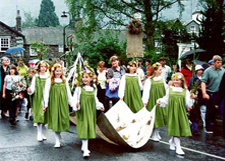
Festivals and other traditions continue to exist in all parts of the country, but their existence depends almost entirely on the continued support of those who live in the local community.
Sport
The sport of all kind plays a major part in many people’s lives. Football, rugby, and cricket all have a large following, and success on the sporting field is a great source of local and national pride.

Major sporting events, such as the Grand National horse race, the Football Association (FA) Cup Final, and the Wimbledon tennis championships, capture the attention of many people in Britain, including those who do not normally follow these sports.
National Days
National days are not celebrated in Britain in the same way as they are in a number of other countries. Only in Northern Ireland (and the Republic of Ireland) is St Patrick’s Day taken as an official holiday. The greatest celebrations are normally reserved for the New Year and the Christian festivals of Christmas and Easter.
National Days
- 1st March St David’s Day, the national day of Wales
- 17th March St Patrick’s Day, the national day of both Northern Ireland and the Republic of Ireland
- 23rd April St George’s Day, the national day of England
- 30th November St Andrew’s Day, the national day of Scotland
There are also four public holidays a year, called Bank Holidays when legislation requires banks and most businesses to close. These are of no nationalistic or religious significance.
Religious and traditional festivals
Most religious festivals in Britain are based on the Christian tradition, but also widely recognised are customs and traditions such as Eid ul-Fitr, Divali and Yom Kippur, belonging to other religions Many of these are explained to children n all the schools as part of their lessons in religious education, and they are celebrated by followers of these faiths in their communities.
The Main Christian and traditional Festivals
Christmas Day, December 25th celebrates the birth of Jesus Christ. It is normally seen as a time to be spent at home with one’s family. Preparations often begin three or four weeks beforehand, as people decide what presents to buy for close family and friends.
A Christmas tree is usually decorated and installed in the entrance hall or living room, around which presents are placed before they are opened on Christmas Day. Christmas cards are normally sent to family and friends from the beginning of December. Non-Christians usually send cards too, which will often simply say ‘Seasons Greetings’.
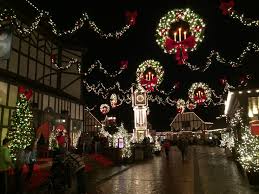
Houses are decorated with special Christmas garlands, and sometimes a wreath of holly on the front door. Mistletoe is often hung above doorways, beneath which couples should traditionally kiss. Christmas is both a religious and a secular holiday, celebrated by believers and non-believers alike. Many families attend a church service, either at midnight on Christmas Eve or on Christmas morning.
Children hang up a long sock, stocking, or pillowcase at the foot of their bed, or around the fireplace for Father Christmas to fill with presents. On Christmas Day families traditionally sit down to a dinner of roast turkey, followed by Christmas pudding – a rich steamed pudding made from suet, dried fruit, and spices.
United Kingdom Facts
The British Father Christmas is a cheerful old man with a beard, dressed in a red suit trimmed with fur. He travels from an area close to the North Pole on a sled pulled by reindeer, delivering presents to children. The Father Christmas we have today is often said to be based on folklore that Dutch, German, and Swedish settlers brought to America, although there are a number of other rival theories explaining his origins.
Boxing Day, the 26th December, refers to a time when servants, gardeners, and other tradespeople used to receive money (a Christmas box) in appreciation for the work they had done throughout the year. Many people stall give postmen. Boxing Day is a holiday in Britain, where people visit family and friends and continue with Christmas festivities. It is also a popular day for sporting activities – weather permitting.
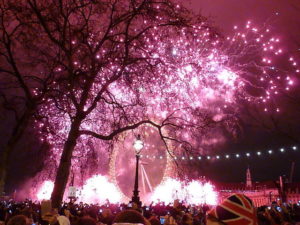
New Year, January 1st, is celebrated in Britain, as it is in many countries throughout the world Parties or celebrations begin on New Year’s Eve, and when midnight arrives everybody cheers and drinks a toast for good luck in the coming year.
In Scotland, New Year can be a bigger festival than Christmas. Here there is a tradition in many homes of first footing, in which the first visitor of the New Year brings in particular items such as coal, bread, and whiskey intended to ensure prosperity for the coming year.
In Wales, on the stroke of midnight, the back door is opened to release the Old Year. It is then locked to keep the luck in, and at the last stroke, the front door opened to let in the New Year.
Easter, which takes place in March or April, commemorates the Crucifixion and Resurrection of Jesus Christ, although it is named after the Saxon goddess of spring, Eostre, whose feast took place at the spring equinox. Easter, like Christmas, has become increasingly secular, and often taken as an opportunity for a holiday.
Easter eggs, made from chocolate (traditionally, decorated chicken’s eggs) are given as presents, particularly to children, symbolizing new life and the coming of spring. Some places hold festivals and fairs on Easter Monday.-
Other Traditions
St Valentine’s Day, February 14th, is the day when boyfriends, girlfriends, husbands, and wives traditionally exchange cards and presents; cards are unsigned as if from secret admirers.
Mothering Sunday, three weeks before Easter, is a day on which children, young and old, remember their mothers by giving them flowers or chocolates and trying to make their day as easy and enjoyable as possible.
April Fool’s Day, April 1st, is the day when people may play jokes on one another – but only until 12 noon. Sometimes even radio, television, and newspapers try to fool people with fake stories and jokes. The tradition is believed to have originated in sixteenth-century France.
Guy Fawkes Night, November 5th, commemorates the Gunpowder Plot in 1605 when a small group of Catholics is said to have plotted to kill the King by blowing up the Houses of Parliament. Soldiers arrested Guido (Guy) Fawkes who was allegedly guarding the explosives beneath Parliament. Today he is remembered with fireworks and the burning of a “Guy” on a bonfire.
United Kingdom Society Facts
Remembrance Day, November 11th, keeps alive the memory of those who died in both World Wars and in later conflicts. Many people now hold a two-minute silence at 11 am in remembrance of this, for it was at the eleventh hour, of the eleventh day, of the eleventh month in 1918 that the First World War (often called the Great War) finally came to an end.
The terrible fighting in the fields of Northern France and Flanders devastated the countryside and, in the disturbed earth of the bomb craters, it was the poppy that was one of the first plants to regrow. So this blood-red flower has come to symbolize the sacrifice of those who fall in war.
Today, in the period before Remembrance Day, artificial poppies are sold in shops and on the streets and many people wear them in their buttonholes in memory of the dead.
More Info On- England trip prepare, Greater Manchester, Kings, and Queens of England UK, UK Nationality